Malankara Research
Research and reflections on the ancient Jacobite Syrian Orthodox Church of Malankara, Kerala
Literature produced by the Malankara Jacobite Syrian Orthodox Christians
- ‘Niranam Grandhavari’ (Niranam Chronicle) :
The earliest literature produced by the Malankara Jacobite Syrians (MJS) are two undatable Chronologies. The first is the ‘Niranam Grandhavari’ (Niranam Chronicle)- a chronology written on Ola, and written and kept by the ‘Archdeacons’- the supreme secular authority of the JS until their first metropolitan was created in 1653. Its latest recension was compiled in the time of Malankara Metropolitan Mar Thoma VI in the last quarter of the 18th c. Two critical editions of it are available now, one by Dr. Kurian Thomas, a strident apologist for the Indian Orth. Church which broke away to form an independent church in 1912. The other is by Paul Manalil, a Roman Catholic. As a result unfortunately, there are gross inaccuracies of interpretation to fit the narrative of one or the other of them, but otherwise good.
2. The Kandanad Grandhavari
The second is the Kandanad Grandhavari, a similar chronicle of unknown provenance, its latest recension having been compiled by the Jacobite metropolitan Shemvoon Mar Dionysius in the late 19th to early 20th c. A 21st c. critical edition has been produced by Fr. Dr. Joseph Cheeran, a priest, scholar, and an arch-apologist for the IOC. Allowing his partisan feelings to colour the editing of this important work, it is sadly dense with abuse of the Syriac Orthodox patriarchs and other holy Church fathers, and the author, like Dr. Kurian Thomas, gives free rein in his erroneous interpretation of events.
Both these chronicles trace the origin and trajectory of the MJS church from the evangelical journeys of St. Thomas the Apostle, touching on all important landmarks of history such as the arrival of the First Syrian Mission of help in 345AD under the merchant Knai Thoma of Jerusalem and Bishop Mar Joseph of Edessa, the Second Syrian Mission of help in 825AD under the Persian Jacobite merchant Sabarisho and the Jacobite bishops Mar Sabor and Mar Aphroth of the monastery of Mar Augen on Mt. Izla. Both parties included large cohorts of ordinary laymen from Edessa and Persia, and they settled in Kodungalloor and Kollam respectively under the protection and patronage of the local kings, thus enabling the native St. Thomas Christians to prosper and flourish, their main occupation being trade in gold, silver, and spices. After these events, the Chronicles mark the arrival of the Portuguese and the beginning of Catholic and oppression short period of Latinisation of the JS (from 1599 to 1653) of the JS.
Niranam ends with the contemporaneous events of Mar Thoma VI (1770-1809), while Kandanad ends with those of its compiler, metropolitan Shemvoon Mar Dionysius in early 20th c.
Other works:
3. The 1771 Ola
This is a manuscript written on Ola that was compiled by several JS priests acting together at the command of Mar Gregorius of Jerusalem, the resident Patriarchal Delegate (who had accompanied the Maphrian Mar Shakrallah), to mark the occasion of the consecration of their new Malankara Metropolitan Mar Thoma VI, also named as Mar Dionysius I.
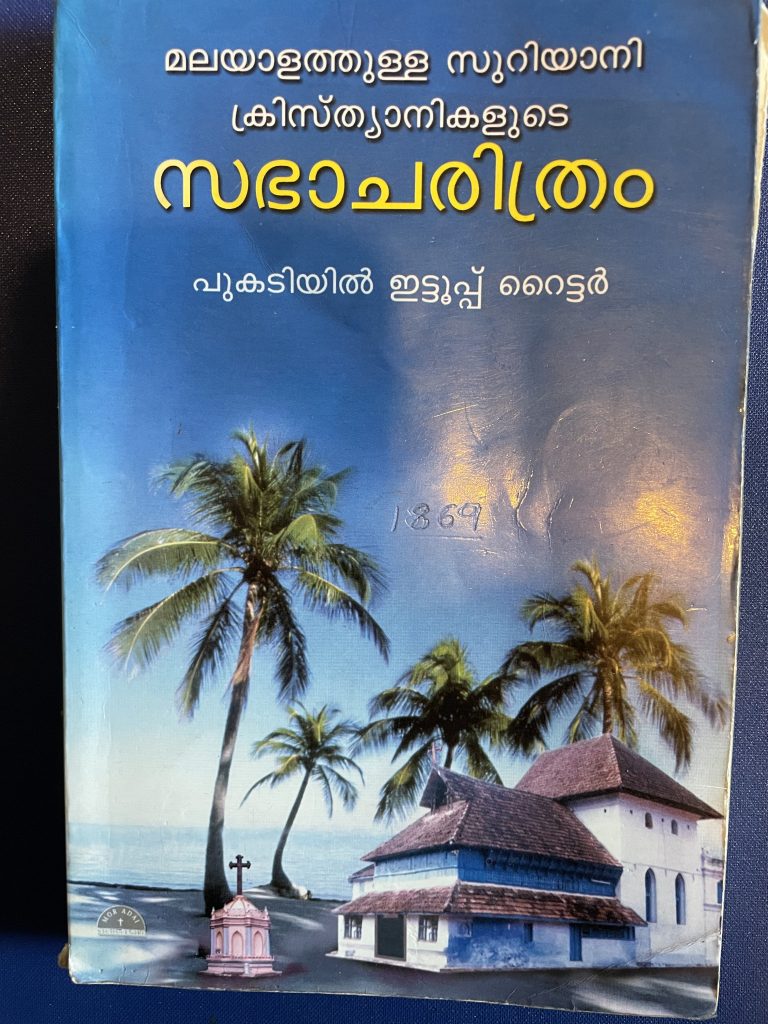
4. Pukadiyil Ittoop’s ‘History of the Syrian Christians of Kerala’ (1869)
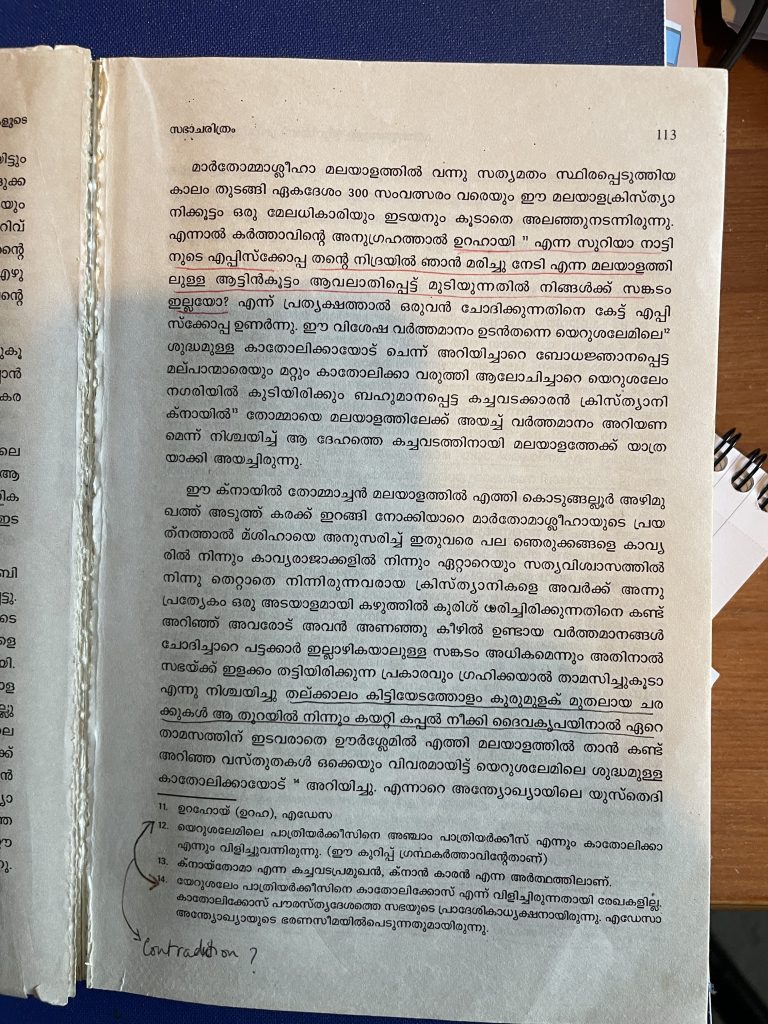
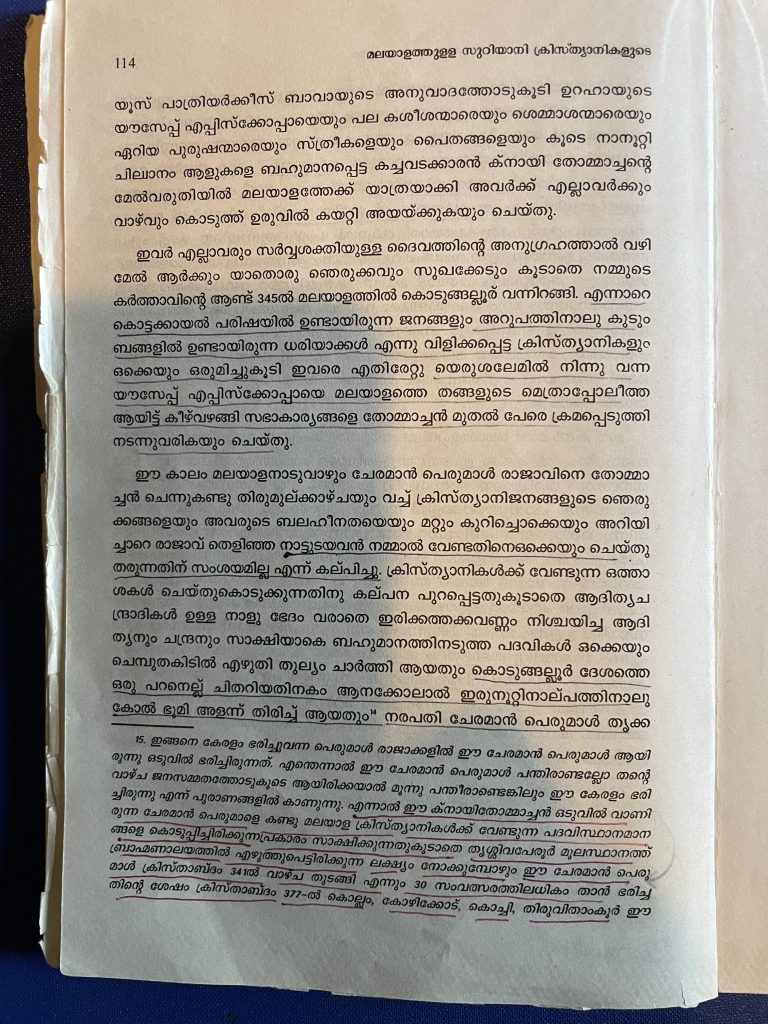
The JS came into the world of printing rather late, in the mid 19th c. Pukadiyil was a prominent JS from Kottayam, who was educated by the CMS missionaries and fairly influenced by Protestant ideologies. Urged by the tensions existent between the JSs and missionary – inspired ‘Reformist’ party among them who wanted to break all ties with Antioch and reform themselves as a Protestant group, he wrote this history from the beginnings of the church till his writing 1869, staying true to all the historical landmarks, personalities, and events, his personal inclinations colouring only aspects of theology towards the end of the book. Most admirably, the value of this remarkable account lies in the fact – as attested by his son and editor of the second edition in the 20th c.- that Pukadiyil was meticulous in his research, collecting and collating his information from the many ola manuscripts that were extant in the possession of JS families as was the custom in those days. It still exists only on Malayalam, but large sections of it has been translated into English by this writer. A small example is given below on Pukadiyil’s account of the arrival of Knai Thoma and party in 345AD:
5.Modern histories
Since the publication of Pukadiyil, there have been many more comprehensive histories of the JSOC. written by prominent historians, of which just three are named below:
a) E. M. Philip: The Indian Church of St. Thomas (written at the turn of the 20th c., but published only in 1950)
b) Kaniamparambil Curien Cor-episcopa : The Syrian Church: its history and true theology (1982)
c) Late Patriarch Mar Ignatius Yacoub III: History of the Syrian Church in India (1952 later trans. into English; Malayalam trans in 2010.)

